mardi 1 juillet 2008

lundi 10 mars 2008
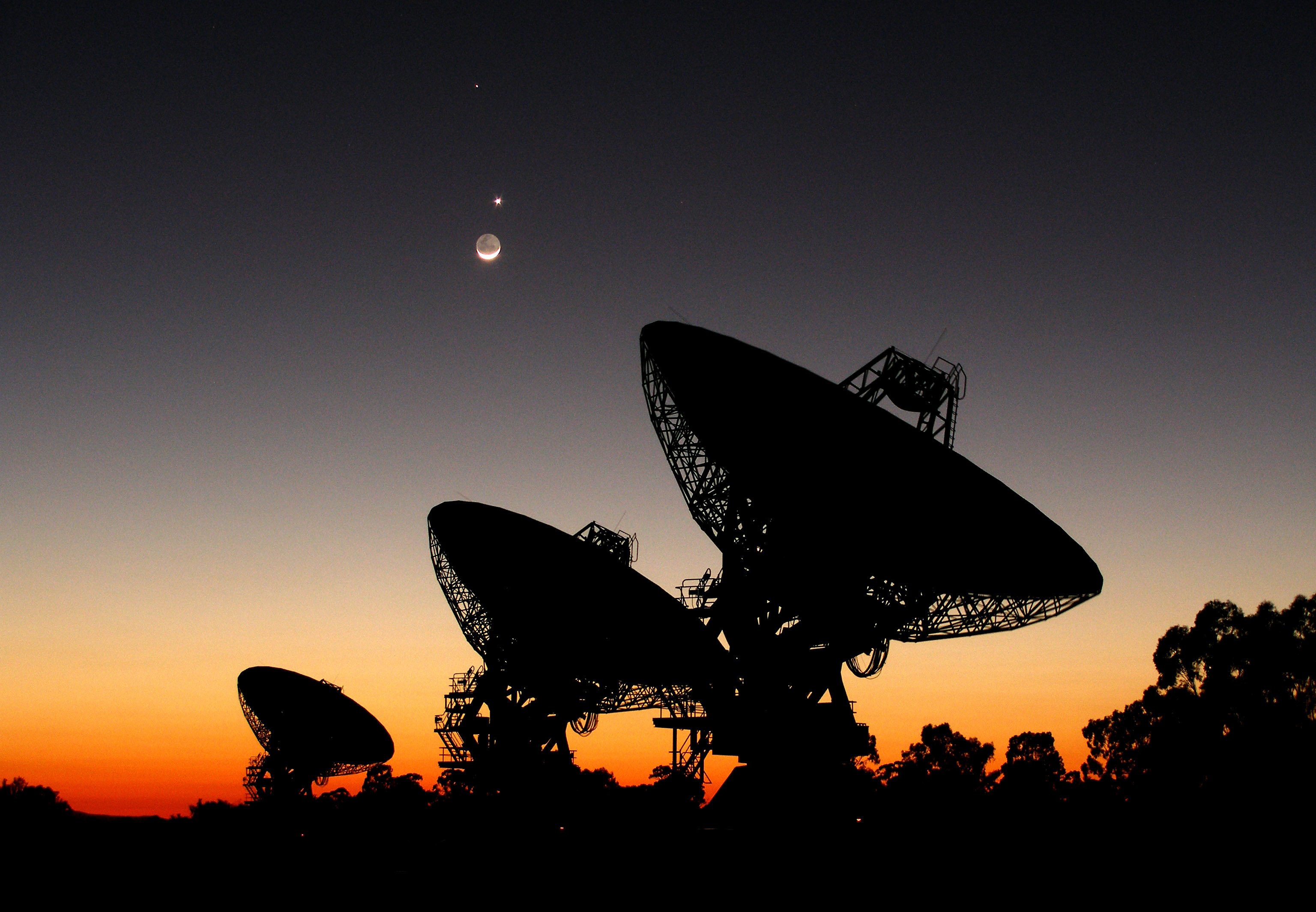
Credit & Copyright: Graeme L. White & Glen Cozens (James Cook University)
Explanation: Last week, Mercury, Venus, and the Moon all appeared close together in Earth's sky. This picturesque conjunction was caught on camera behind elements of the Australia Telescope Compact Array (ATCA) near the town of Narrabri in rural New South Wales. The ATCA consists of six radio telescopes in total, each one larger than a house. Together they form one of the highest resolution measurement devices in the world. Impressive planetary conjunctions occur every few years. Involving the brightest objects in the night sky, this alignment was easy to spot just before sunrise. In the picture, taken on the morning of March 6, Mercury is the highest of the three bright celestial beacons.
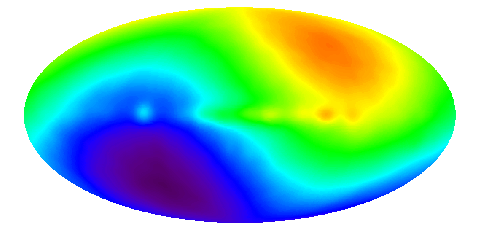
Credit: DMR, COBE, NASA, Four-Year Sky Map
Explanation: Our Earth is not at rest. The Earth moves around the Sun. The Sun orbits the center of the Milky Way Galaxy. The Milky Way Galaxy orbits in the Local Group of Galaxies. The Local Group falls toward the Virgo Cluster of Galaxies. But these speeds are less than the speed that all of these objects together move relative to the cosmic microwave background radiation (CMBR). In the above all-sky map from the COBE satellite, radiation in the Earth's direction of motion appears blueshifted and hence hotter, while radiation on the opposite side of the sky is redshifted and colder. The map indicates that the Local Group moves at about 600 kilometers per second relative to this primordial radiation. This high speed was initially unexpected and its magnitude is still unexplained. Why are we moving so fast? What is out there?
vendredi 7 mars 2008
M104 Hubble Remix
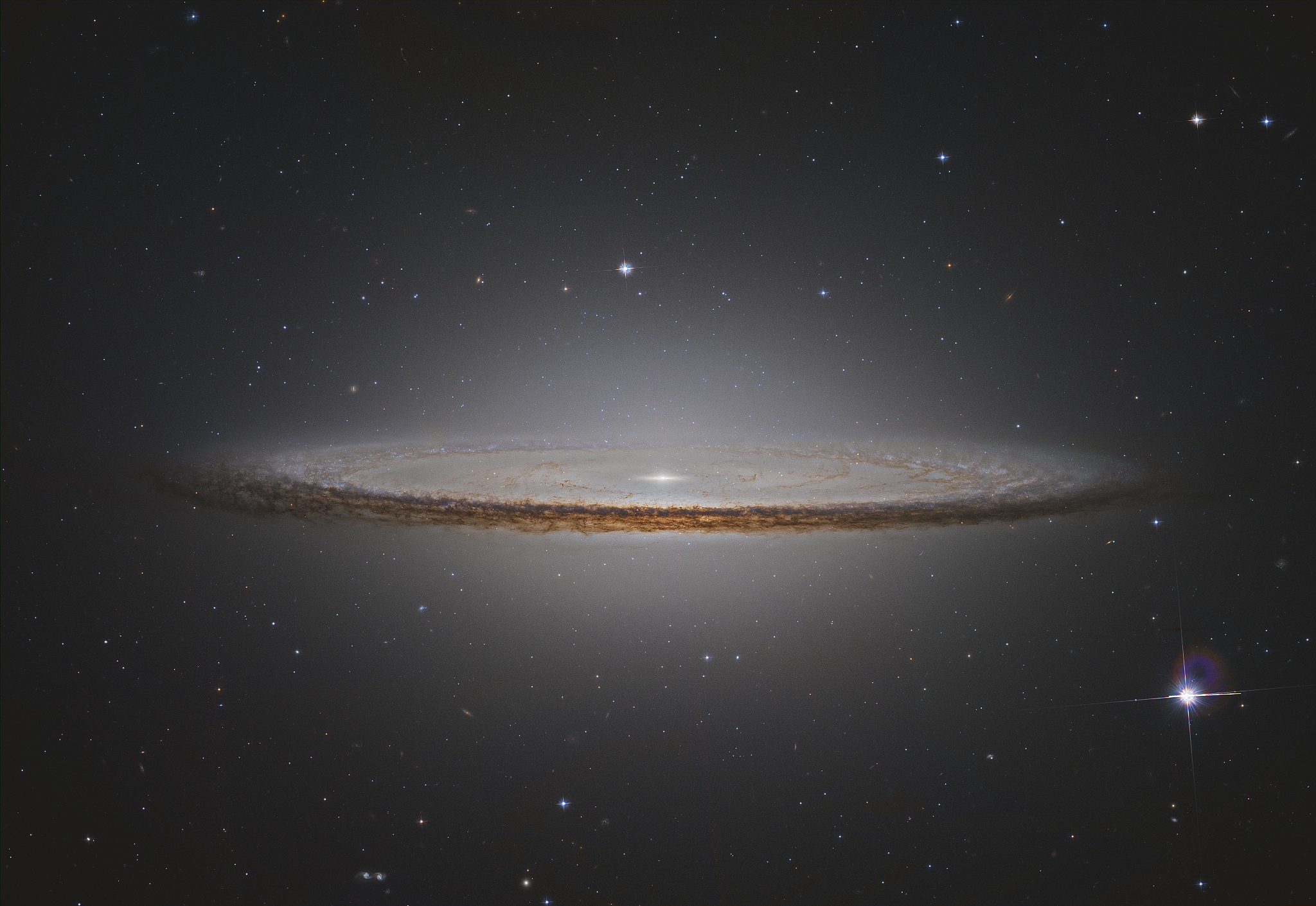
Credit & Copyright: Vicent Peris (OAUV / PTeam), MAST, STScI, AURA, NASA
Explanation: The striking spiral galaxy M104 is famous for its nearly edge-on profile featuring a broad ring of obscuring dust. Seen in silhouette against a bright bulge of stars, the swath of cosmic dust lanes lends a hat-like appearance to the galaxy in optical images suggesting the more popular moniker, The Sombrero Galaxy. Here, Hubble Space Telescope archival image data has been reprocessed to create this alternative look at the well-known galaxy. The newly developed processing improves the visibility of details otherwise lost in overwhelming glare, in this case allowing features of the galaxy's dust lanes to be followed well into the bright central region. About 50,000 light-years across and 28 million light-years away, M104 is one of the largest galaxies at the southern edge of the Virgo Galaxy Cluster.

Credit & Copyright: P-M Hedén (Clear Skies, TWAN)
Explanation: Still gracing northern skies, a fading Comet Holmes lies at the top edge of this colorful skyview, recorded on March 4. The reddish emission nebula below it is NGC 1499, also known as the California Nebula for its resemblance to the outline of the state on the US west coast. Of course, the two cosmic clouds by chance lie along nearly the same line-of-sight and so only appear to be close together and of similar size. The California Nebula is actually about 100 light-years long and 1,500 light-years away, drifting through the Orion Arm of our spiral Milky Way Galaxy. Comet Holmes is about 20 light-seconds in diameter, sweeping through our solar system a mere 25 light-minutes away, beyond the orbit of Mars. The molecules of the comet's gaseous coma fluoresce in sunlight. The California Nebula's glow is characteristic of hydrogen atoms recombining with long lost electrons, originally stripped away (ionized) by ultraviolet starlight. Providing the energetic starlight is Xi Persei, the prominent star below the nebula.
jeudi 6 mars 2008
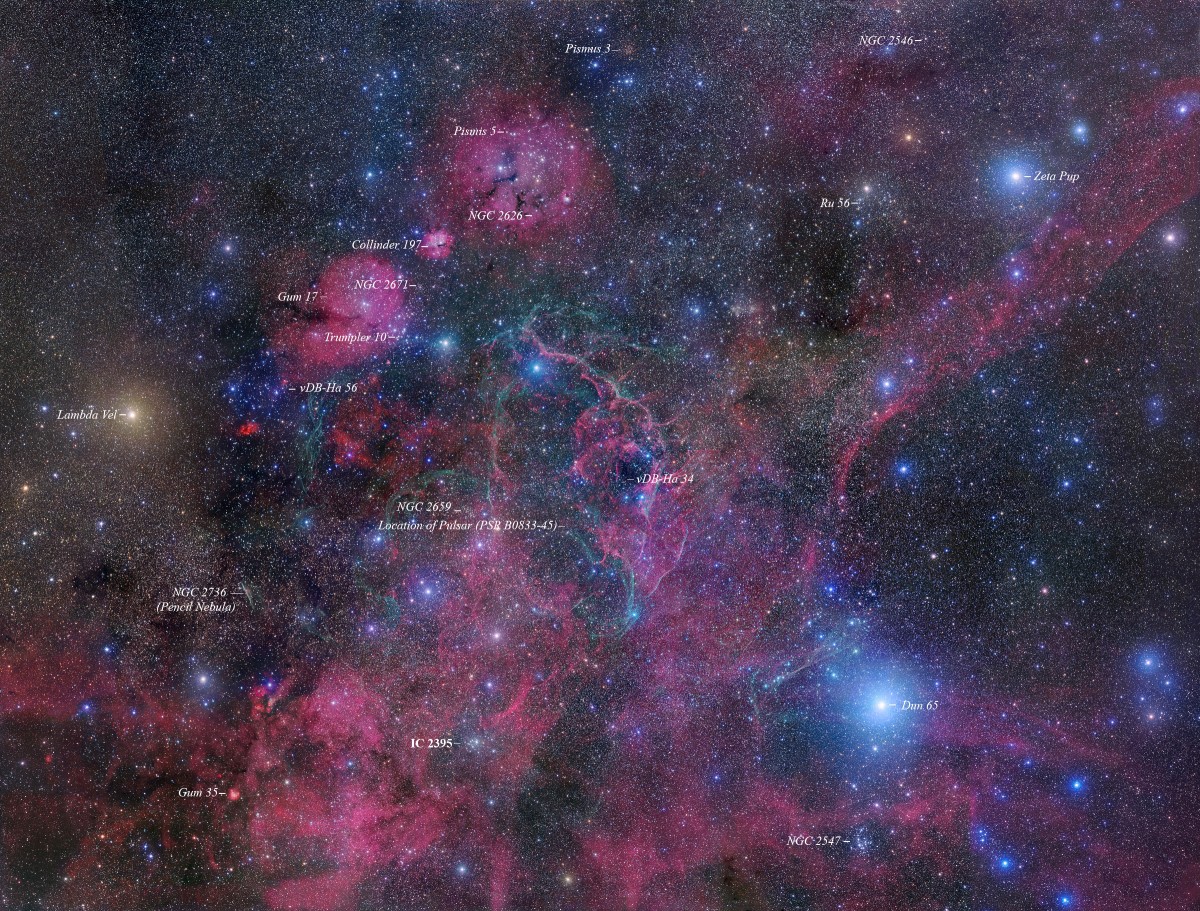
Vela Supernova Remnant
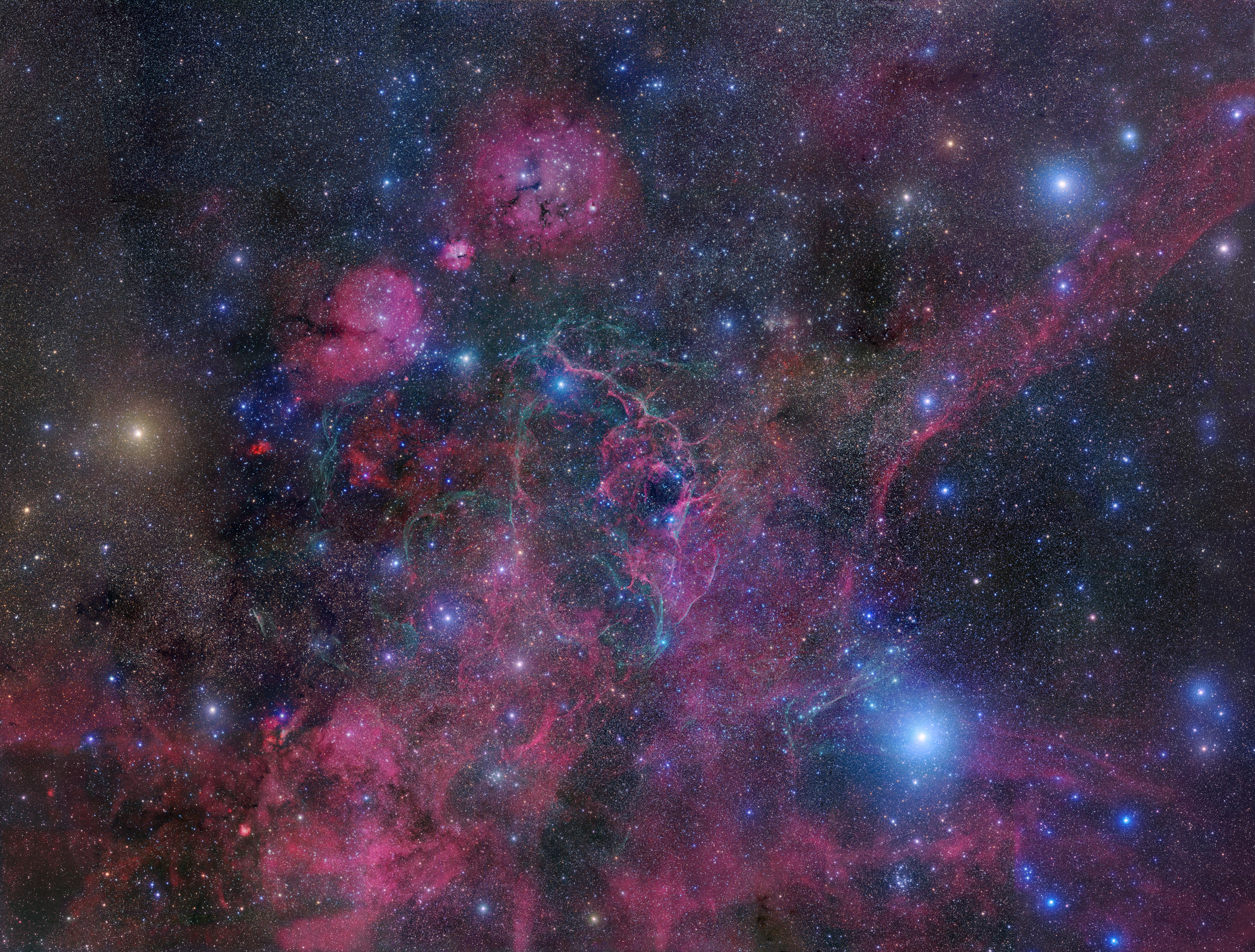
Credit & Copyright: Robert Gendler
Explanation: The plane of our Milky Way Galaxy runs through this complex and beautiful skyscape. At the northwestern edge of the constellation Vela (the Sails) the 16 degree wide, 30 frame mosaic is centered on the glowing filaments of the Vela Supernova Remnant, the expanding debris cloud from the death explosion of a massive star. Light from the supernova explosion that created the Vela remnant reached Earth about 11,000 years ago. In addition to the shocked filaments of glowing gas, the cosmic catastrophe also left behind an incredibly dense, rotating stellar core, the Vela Pulsar. Some 800 light-years distant, the Vela remnant is likely embedded in a larger and older supernova remnant, the Gum Nebula. The broad mosaic includes other identified emission and reflection nebulae, star clusters, and the remarkable Pencil Nebula.
mercredi 5 mars 2008
The International Space Station Expands Again
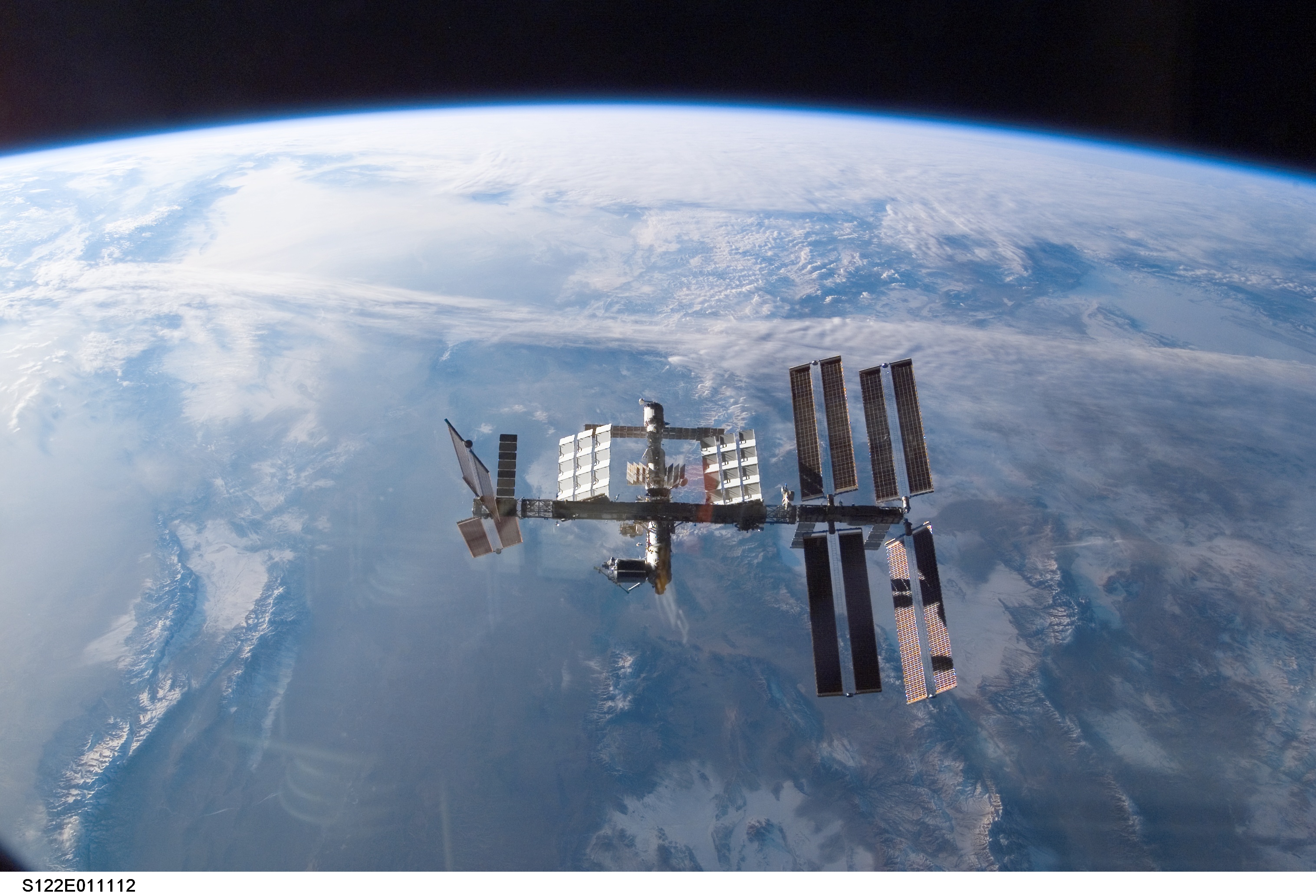
Credit: STS-122 Shuttle Crew, NASA
Explanation: The developing International Space Station (ISS) has changed its appearance again. Last month, the Space Shuttle orbiter Atlantis visited the ISS and added components that included the Columbus Science Laboratory. The entire array of expansive solar panels is visible in this picture taken by the Atlantis Crew after leaving the ISS to return to Earth. The world's foremost space outpost can be seen developing over the past several years by comparing the above image to past images. Also visible above are many different types of modules, a robotic arm, another impressive set of solar panels, and a supply ship. Construction began on the ISS in 1998.
mardi 4 mars 2008
NGC 6334: The Cat's Paw Nebula
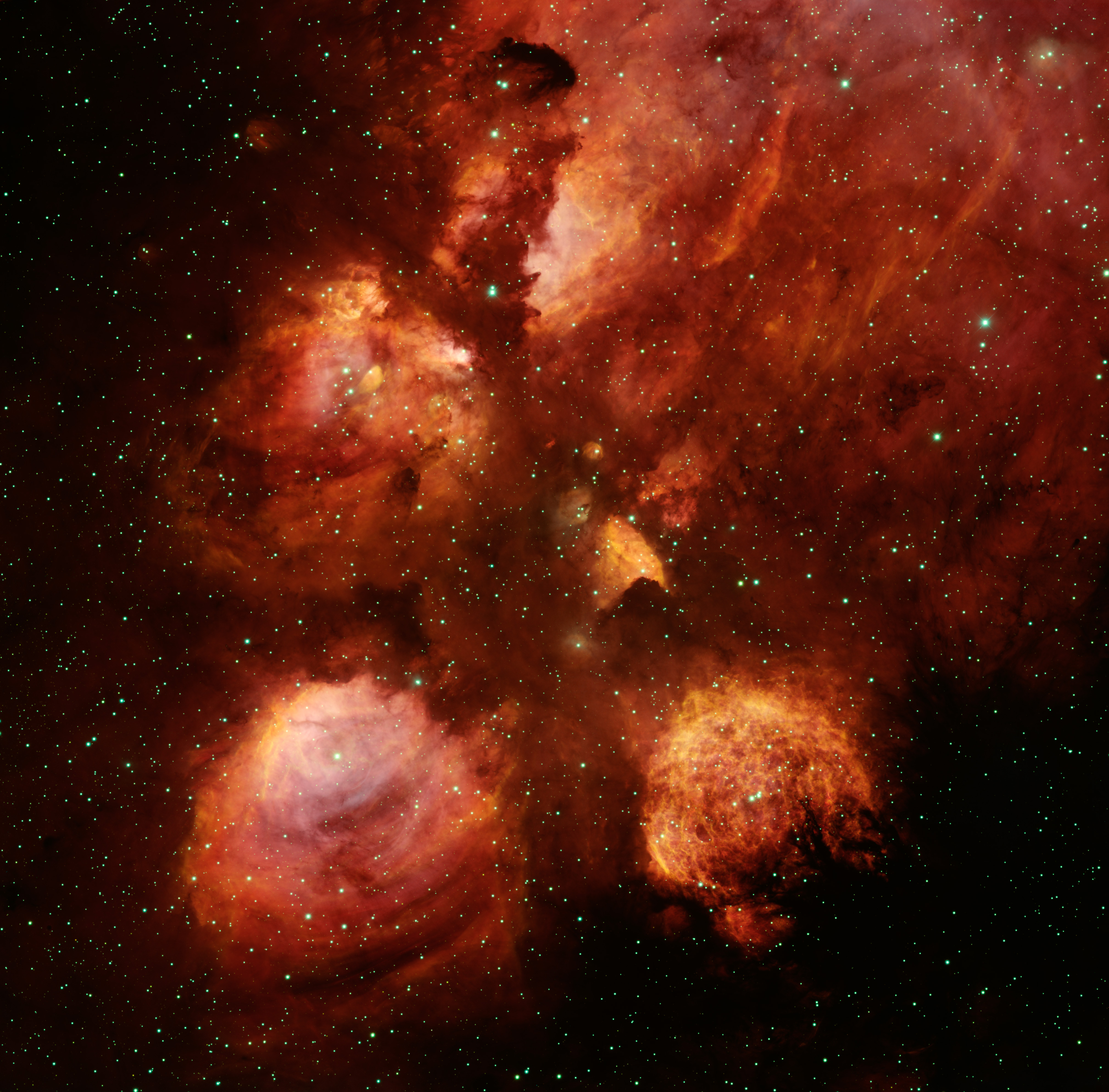
Credit & Copyright: T. A. Rector (U. Alaska), T. Abbott, NOAO, AURA, NSF
Explanation: Nebulae are perhaps as famous for being identified with familiar shapes as perhaps cats are for getting into trouble. Still, no known cat could have created the vast Cat's Paw Nebula visible in Scorpius. At 5,500 light years distant, Cat's Paw is an emission nebula with a red color that originates from an abundance of ionized hydrogen atoms. Alternatively known as the Bear Claw Nebula or NGC 6334, stars nearly ten times the mass of our Sun have been born there in only the past few million years. Pictured above, the end of the Cat's Paw nebula was imaged from the Blanco 4-meter Telescope in Chile.
dimanche 25 février 2007
X-rays and the Eagle Nebula

X-rays and the Eagle Nebula
Credit: X-ray: NASA/CXC/J.Linsky (U.Colorado) et al.; Optical: NASA/ESA/STScI/J.Hester, P.Scowen (ASU)
Explanation: The premier Chandra X-ray Observatory images of M16, the Eagle Nebula, show many bright x-ray sources in the region. Most of the x-ray sources are energetic young stars. They are seen here as colored spots superimposed on the Hubble's well-known optical view of M16's light-year long Pillars of Creation. For example, a blue source near the tip of the large pillar at the upper left is estimated to be an embedded young star 4 or 5 times as massive as the Sun. Still, most of the x-ray sources are not coincident with the pillars themselves, indicating that embedded stars are not common in the dusty structures. The mostly empty pillars are thought to be an indication that star formation actually peaked millions of years ago within the Eagle Nebula.
the far side of the moon
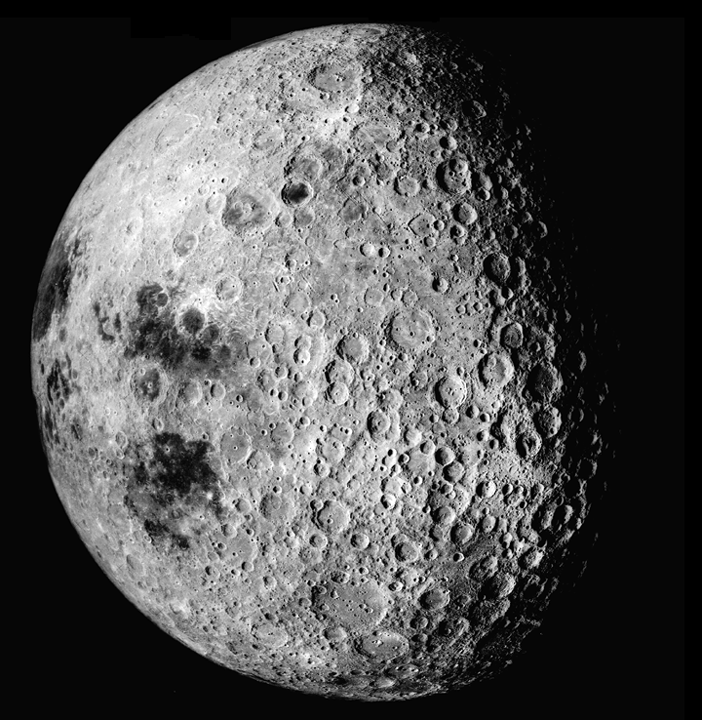
The Far Side of the Moon
Credit: Apollo 16 Crew, NASA
Explanation: Does this moon look familiar? Possibly not, even though it is Earth's Moon. Locked in synchronous rotation, the Moon always presents its well-known near side to Earth. But from lunar orbit, Apollo astronauts also grew to know the Moon's far side. This sharp picture from Apollo 16's mapping camera shows the eastern edge of the familiar near side (top) and the strange and heavily cratered far side of the Moon. Surprisingly, the rough and battered surface of the far side looks very different from the near side which is covered with smooth dark lunar maria. The likely explanation is that the far side crust is thicker, making it harder for molten material from the interior to flow to the surface and form the smooth maria.
dimanche 11 février 2007
IO
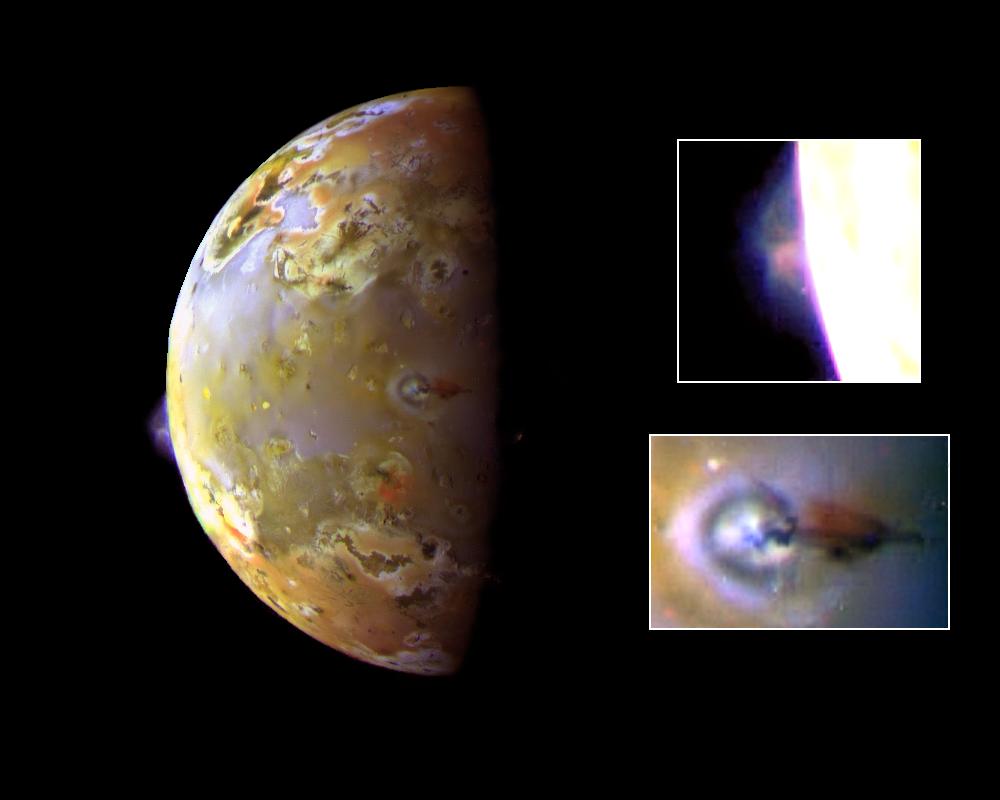
Io: The Prometheus Plume
Credit: Galileo Project, JPL, NASA
Explanation: What's happening on Jupiter's moon Io? Two sulfurous eruptions are visible on Jupiter's volcanic moon Io in this color composite image from the robotic Galileo spacecraft that orbited Jupiter from 1995 to 2003. At the image top, over Io's limb, a bluish plume rises about 140 kilometers above the surface of a volcanic caldera known as Pillan Patera. In the image middle, near the night/day shadow line, the ring shaped Prometheus plume is seen rising about 75 kilometers above Io while casting a shadow below the volcanic vent. Named for the Greek god who gave mortals fire, the Prometheus plume is visible in every image ever made of the region dating back to the Voyager flybys of 1979 - presenting the possibility that this plume has been continuously active for at least 18 years. The above digitally sharpened image was originally recorded in 1997 on June 28 from a distance of about 600,000 kilometers.
vendredi 9 février 2007
moon
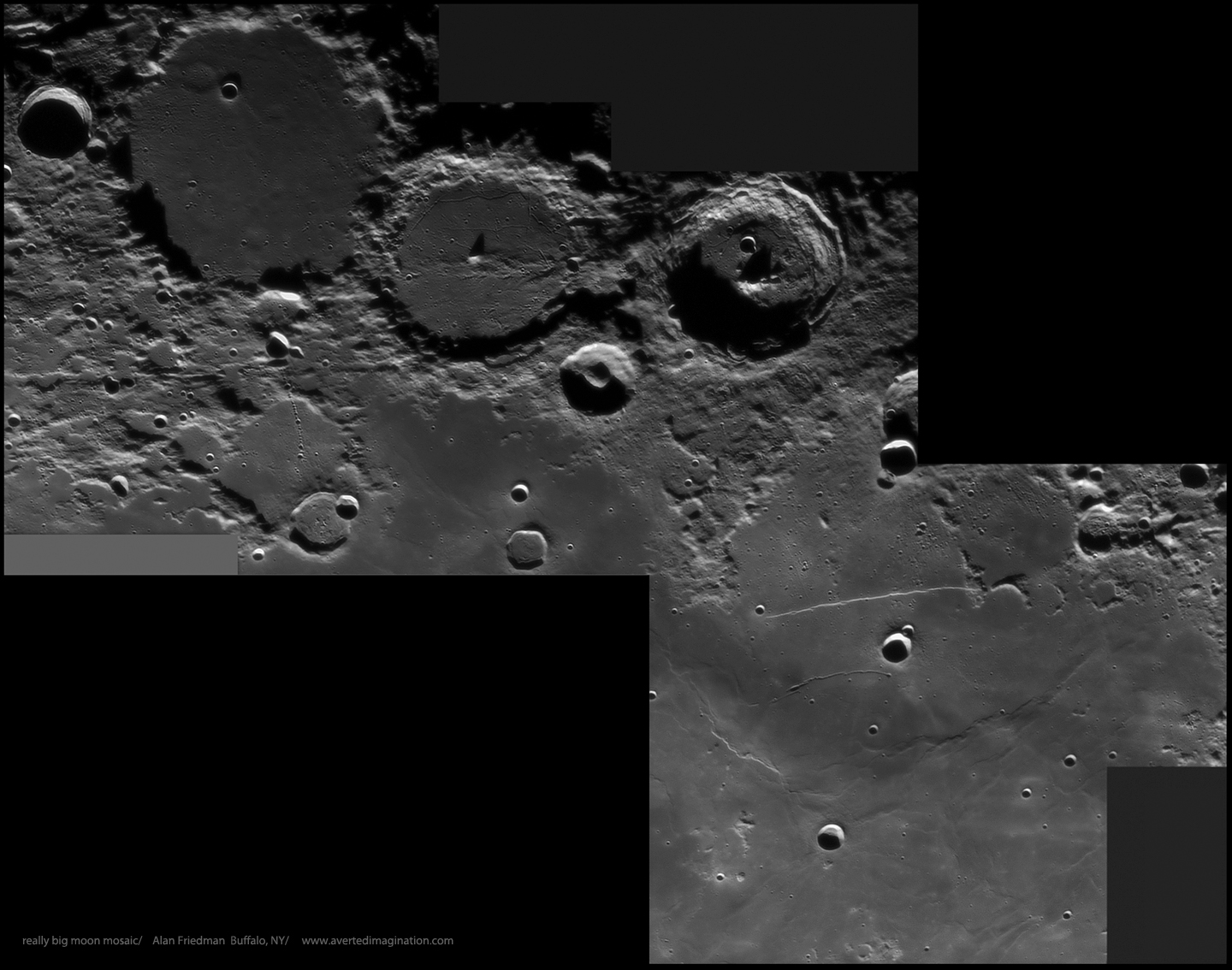
Ptolemaeus, Alphonsus and Arzachel
Credit & Copyright: Alan Friedman
Explanation: These three ancient, large impact craters lie on the north eastern shores of Mare Nubium, the lunar Sea of Clouds. Along the top of the stark mosaic (left to right) are the namesakes of Ptolemaeus, Alphonsus and Arzachel. The picture offers a remarkably detailed view of the well-studied region with shadows emphasizing the large crater central peaks and slumping walls. Careful examination also reveals the 110 kilometer long Straight Wall, a fault 200-300 meters high, and the intriguing Davy crater chain. Overall, the striking moonscape is similar to the final images recorded by the Ranger 9 spacecraft, before it crashed into the 108 kilometer wide crater Alphonsus in March of 1965