dimanche 25 février 2007

X-rays and the Eagle Nebula


X-rays and the Eagle Nebula
Credit: X-ray: NASA/CXC/J.Linsky (U.Colorado) et al.; Optical: NASA/ESA/STScI/J.Hester, P.Scowen (ASU)
Explanation: The premier Chandra X-ray Observatory images of M16, the Eagle Nebula, show many bright x-ray sources in the region. Most of the x-ray sources are energetic young stars. They are seen here as colored spots superimposed on the Hubble's well-known optical view of M16's light-year long Pillars of Creation. For example, a blue source near the tip of the large pillar at the upper left is estimated to be an embedded young star 4 or 5 times as massive as the Sun. Still, most of the x-ray sources are not coincident with the pillars themselves, indicating that embedded stars are not common in the dusty structures. The mostly empty pillars are thought to be an indication that star formation actually peaked millions of years ago within the Eagle Nebula.

the far side of the moon


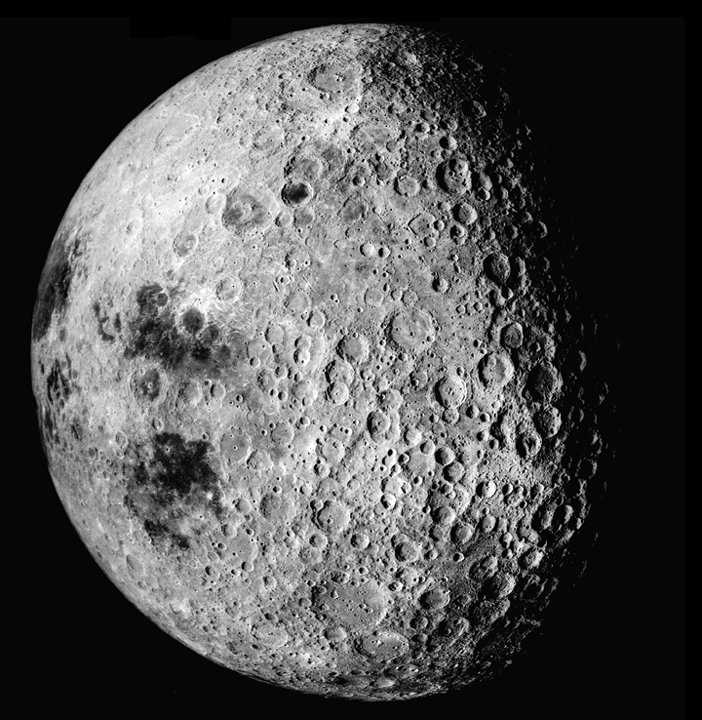
The Far Side of the Moon
Credit: Apollo 16 Crew, NASA
Explanation: Does this moon look familiar? Possibly not, even though it is Earth's Moon. Locked in synchronous rotation, the Moon always presents its well-known near side to Earth. But from lunar orbit, Apollo astronauts also grew to know the Moon's far side. This sharp picture from Apollo 16's mapping camera shows the eastern edge of the familiar near side (top) and the strange and heavily cratered far side of the Moon. Surprisingly, the rough and battered surface of the far side looks very different from the near side which is covered with smooth dark lunar maria. The likely explanation is that the far side crust is thicker, making it harder for molten material from the interior to flow to the surface and form the smooth maria.

dimanche 11 février 2007

IO


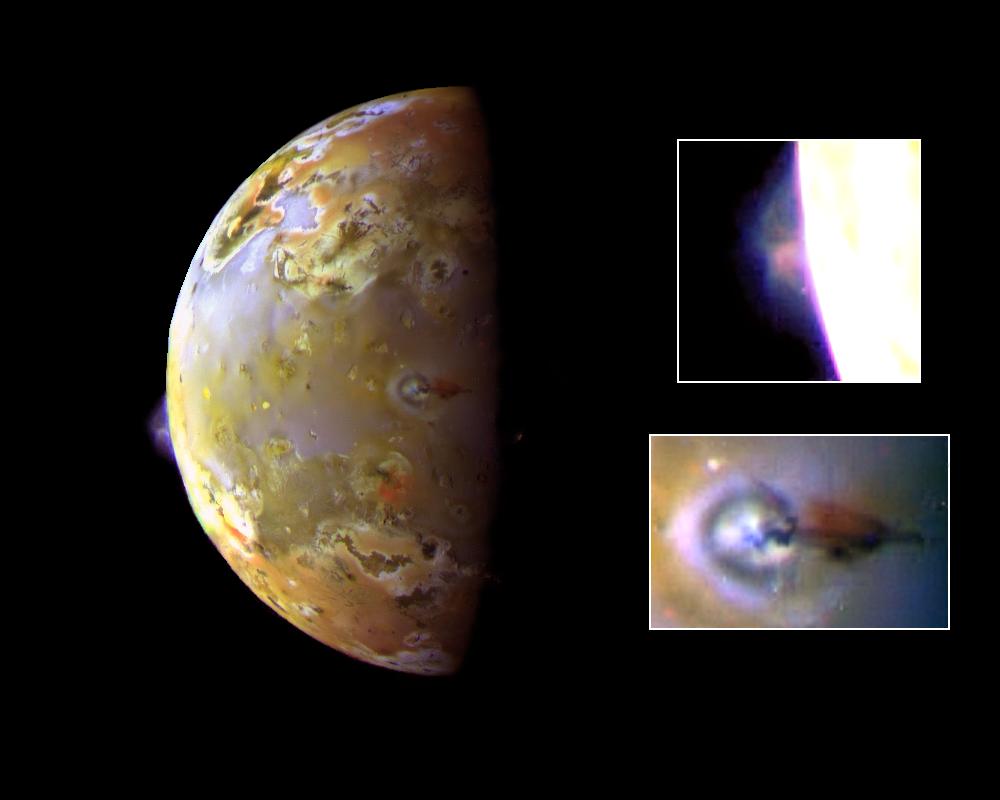
Io: The Prometheus Plume
Credit: Galileo Project, JPL, NASA
Explanation: What's happening on Jupiter's moon Io? Two sulfurous eruptions are visible on Jupiter's volcanic moon Io in this color composite image from the robotic Galileo spacecraft that orbited Jupiter from 1995 to 2003. At the image top, over Io's limb, a bluish plume rises about 140 kilometers above the surface of a volcanic caldera known as Pillan Patera. In the image middle, near the night/day shadow line, the ring shaped Prometheus plume is seen rising about 75 kilometers above Io while casting a shadow below the volcanic vent. Named for the Greek god who gave mortals fire, the Prometheus plume is visible in every image ever made of the region dating back to the Voyager flybys of 1979 - presenting the possibility that this plume has been continuously active for at least 18 years. The above digitally sharpened image was originally recorded in 1997 on June 28 from a distance of about 600,000 kilometers.

vendredi 9 février 2007

moon


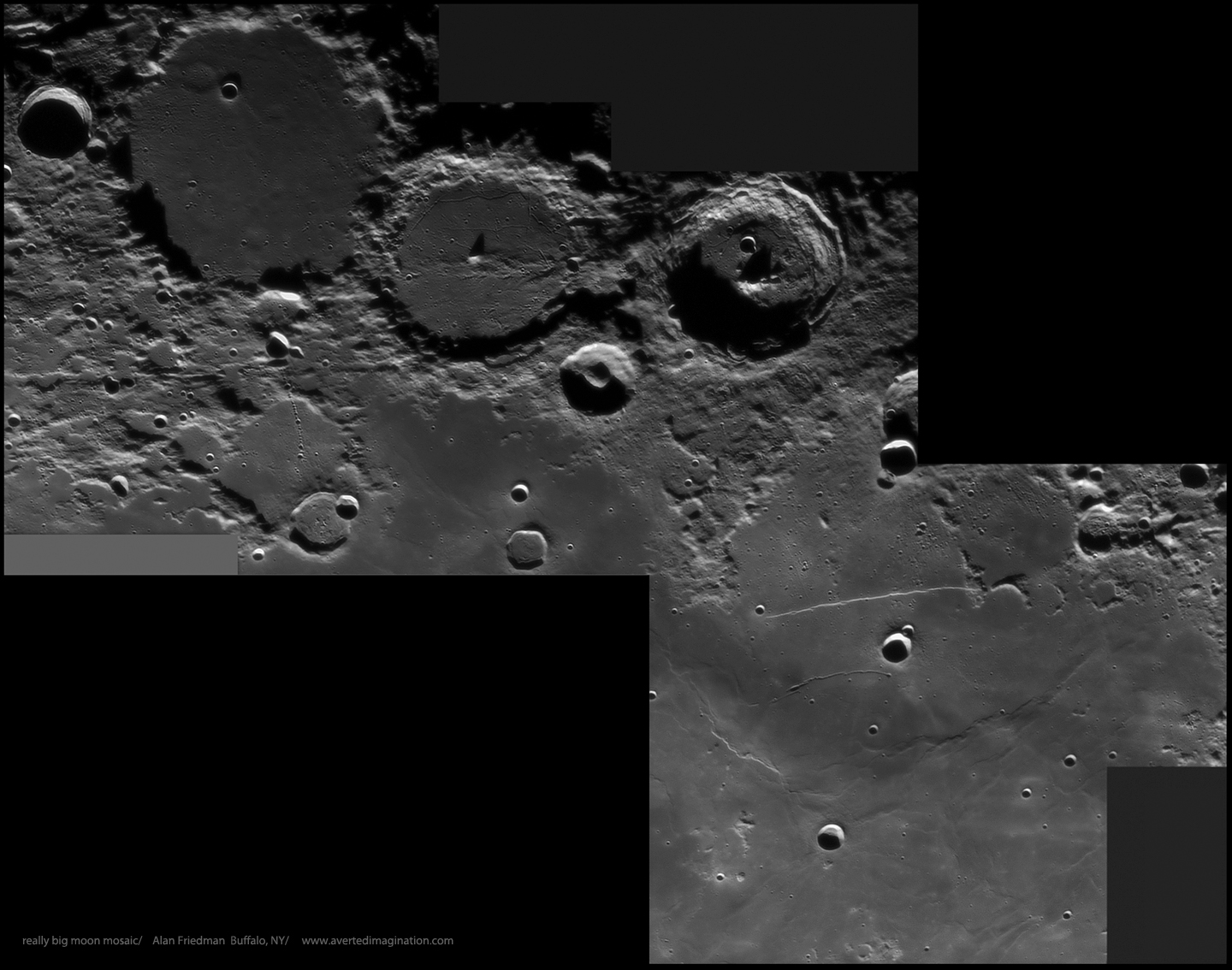
Ptolemaeus, Alphonsus and Arzachel
Credit & Copyright: Alan Friedman
Explanation: These three ancient, large impact craters lie on the north eastern shores of Mare Nubium, the lunar Sea of Clouds. Along the top of the stark mosaic (left to right) are the namesakes of Ptolemaeus, Alphonsus and Arzachel. The picture offers a remarkably detailed view of the well-studied region with shadows emphasizing the large crater central peaks and slumping walls. Careful examination also reveals the 110 kilometer long Straight Wall, a fault 200-300 meters high, and the intriguing Davy crater chain. Overall, the striking moonscape is similar to the final images recorded by the Ranger 9 spacecraft, before it crashed into the 108 kilometer wide crater Alphonsus in March of 1965